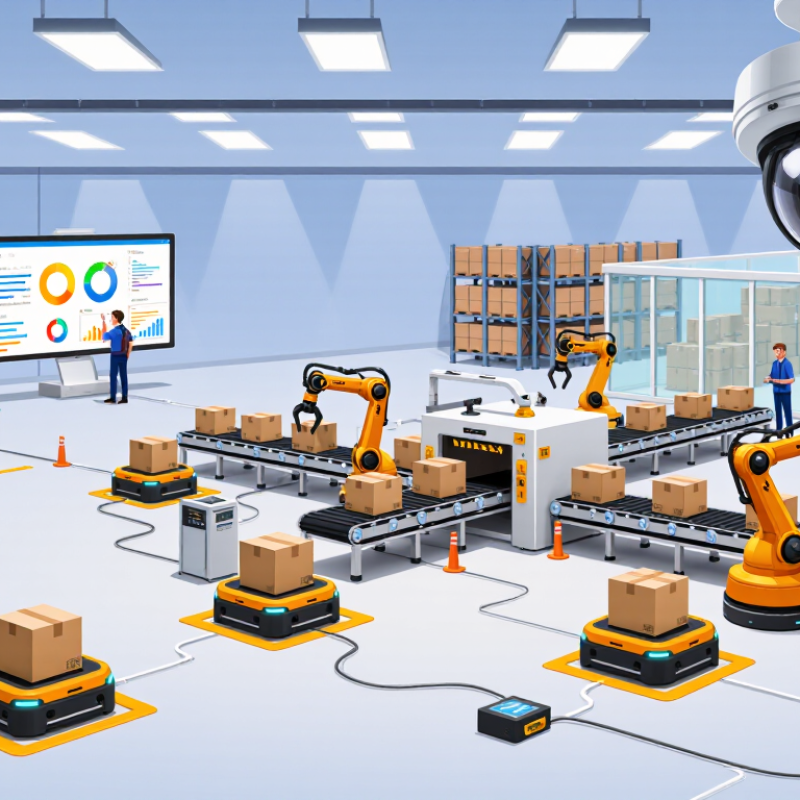
In 2026, technology automation is becoming a practical purchasing priority for global buyers. It connects factories, warehouses, offices, and service teams through smarter software and connected equipment. Buyers now expect measurable improvements, not impressive demonstrations alone. They want shorter production cycles, fewer manual errors, clearer inventory data, and faster customer responses.
This article examines the technology automation trends shaping international procurement decisions. It considers artificial intelligence, robotic process automation, industrial robots, low-code platforms, digital twins, and edge computing. Each trend can solve a specific operational problem. For example, a warehouse camera system may identify damaged packaging before shipment. A connected machine can send maintenance alerts before a costly breakdown. These details matter when comparing suppliers across different markets.
Practical experience shows that automation projects rarely succeed through technology alone. Staff training, system compatibility, cybersecurity, and reliable technical support are equally important. A lower purchase price may hide expensive integration work. Global buyers should also check certification, data handling practices, warranty coverage, and local service capacity. Not every automated process needs advanced artificial intelligence. Sometimes, a simple approval workflow delivers better value.
The market is moving quickly, but the direction is not always clear. Some solutions remain difficult to scale. Others promise efficiency while creating new monitoring burdens. This article therefore balances verified capabilities with realistic limitations. It offers a careful framework for evaluating suppliers, reducing purchasing risks, and choosing automation that supports long-term business performance. Progress matters. So does restraint.
Automation in 2026 means using software, machines, sensors, and intelligent decision systems to complete repeatable work with limited human intervention. It is more than factory robotics. Its scope includes production, warehousing, procurement, transport, customer service, energy management, and quality inspection. In practical procurement reviews, buyers increasingly examine the whole workflow, from incoming materials to final delivery. Small details matter. A sensor may detect temperature changes, while software adjusts production schedules within minutes.
For global buyers, automation has become essential market infrastructure. It can shorten processing times, reduce manual errors, and improve output consistency across different locations. A warehouse worker may scan one package, and the system can update inventory, routing, and delivery records immediately. These gains support faster international trade and more predictable purchasing decisions. However, automation does not remove every business risk. Poor data, weak maintenance, and unclear human oversight can create expensive failures.
The global market importance of automation also comes from its flexibility. Buyers can select modular systems that fit changing production volumes and regional requirements. They should assess integration, training, data protection, repair access, and measurable performance. A supplier’s impressive demonstration may not reflect daily operating conditions. Real testing often reveals delays, compatibility issues, or skills shortages. That gap deserves careful attention. Automation is powerful, but it still needs accountable people, realistic budgets, and continuous review.
In 2026, automation adoption is moving from isolated pilots to connected operating systems. Artificial intelligence helps procurement teams read invoices, detect demand shifts, and flag unusual costs. Machine learning improves forecasts when data is clean and current. That condition matters. Many buyers still discover duplicated records, missing timestamps, and inconsistent product codes during deployment. Experience shows that automation exposes weak processes before it creates savings.
Industrial IoT sensors now monitor temperature, vibration, energy use, and machine downtime. Edge computing processes urgent signals near equipment, reducing delays when connectivity is unstable. Collaborative robots support repetitive assembly, inspection, and warehouse picking beside trained workers. Digital twins let engineering teams test layout changes before moving physical equipment. These tools work best with clear ownership, measurable baselines, and human review for exceptional cases. Without those controls, speed can hide errors.
Automation platforms increasingly combine workflow automation, predictive analytics, and secure data exchange. For global buyers, multilingual interfaces and regional data requirements deserve early testing. A practical evaluation should measure setup time, integration effort, maintenance skills, and recovery after failure. Do not trust a polished demonstration alone. A small production trial often reveals sensor drift, unclear permissions, or staff resistance. Some projects will underperform. That is useful evidence, not a reason to abandon automation.
Key technologies driving automation adoption in 2026
Artificial intelligence and information-processing technologies rank as the leading automation priority, followed by robotics, automation systems, cybersecurity, and advanced computing. These figures represent the share of surveyed employers expecting each technology to transform their business by 2030 and provide a data-based benchmark for 2026 investment planning.
Source: World Economic Forum, Future of Jobs Report 2025. Percentages reflect global employer expectations.
In 2026, automation will move beyond isolated factory machines. Global buyers will seek connected systems that improve production, logistics, and service operations. Smart sensors can monitor vibration, temperature, and energy use in real time. Maintenance teams receive alerts before a conveyor belt stops. This reduces downtime, but poor sensor calibration can create expensive false alarms.
Manufacturers can combine robotics, machine vision, and digital twins for flexible assembly lines. A digital twin tests production changes before workers adjust physical equipment. In warehouses, automated vehicles can sort cartons, count inventory, and support safer picking. Food processors may use vision systems to detect damaged packaging. Agricultural businesses can apply automated irrigation after measuring soil moisture. These use cases require local language support, reliable connectivity, and clear worker training.
Healthcare facilities can automate appointment routing, inventory checks, and equipment tracking. Energy operators can use predictive analytics to balance demand and identify abnormal consumption. Global procurement teams should examine data protection, cybersecurity, integration standards, and total ownership costs. A low purchase price can hide training fees or difficult maintenance. Human review remains necessary when systems affect safety, quality, or customer access. Practical trials often reveal uncomfortable gaps. Some workflows are too irregular for full automation. Buyers should measure results with transparent benchmarks, independent testing, and documented audit trails. Continuous improvement matters more than impressive demonstrations.
A practical comparison of automation technologies, measurable market evidence, industry applications, implementation requirements, and buyer priorities.
| Rank | Automation Trend | Technology Category | Market Evidence or Benchmark | Typical Industry Applications | Primary Buyer Use Cases | Key Performance Indicators | Implementation Maturity | Typical Deployment Period | Core Requirements | Main Risks and Controls |
|---|---|---|---|---|---|---|---|---|---|---|
| 1 | Industrial Robotics and Collaborative Robots | Physical automation, machine vision, motion control | 541,302 industrial robots were installed globally in 2023; the global operational stock exceeded 4.28 million units in the same year. | Automotive, electronics, metalworking, logistics, food processing, pharmaceuticals | Machine tending, welding, assembly, palletizing, packaging, quality inspection, material handling | Units per hour, first-pass yield, unplanned downtime, labor hours per unit, workplace incidents | High | 3–12 months for a standard cell; 12–24 months for a multi-line program | Defined work envelope, safety assessment, end-of-arm tooling, operator training, reliable production data | Integration complexity and safety exposure; use risk assessments, guarding, validation, and staged commissioning |
| 2 | AI-Powered Process Automation | Machine learning, generative AI, intelligent document processing | In a 2024 global enterprise survey, 72% of respondents reported that their organizations had adopted AI in at least one business function. | Banking, insurance, healthcare administration, procurement, customer operations, professional services | Document classification, claims intake, quotation analysis, service-agent assistance, exception handling, knowledge search | Processing time, automation rate, accuracy, cost per transaction, exception rate, response time | High | 6–16 weeks for a focused workflow; 6–12 months for governed enterprise scale | Clean documents and data, workflow ownership, model monitoring, access controls, human review rules | Hallucination, bias, privacy, and model drift; use approval gates, evaluation datasets, audit logs, and restricted data access |
| 3 | Industrial Internet of Things and Edge Analytics | Connected sensors, edge computing, real-time analytics | Industrial IoT deployments commonly use condition data to support predictive maintenance; vibration, temperature, pressure, and current are established monitoring signals for rotating equipment. | Manufacturing, utilities, mining, oil and gas, transportation, water treatment | Predictive maintenance, energy monitoring, asset tracking, remote diagnostics, production visibility | Mean time between failures, maintenance cost, energy intensity, asset utilization, alert precision | High | 2–6 months for a pilot; 9–18 months for plant-wide deployment | Sensor compatibility, network coverage, time-synchronized data, asset hierarchy, maintenance process integration | Cybersecurity and poor data quality; use network segmentation, device identity, secure updates, and sensor calibration |
| 4 | Digital Twins and Simulation-Based Optimization | 3D modeling, process simulation, operational analytics | Digital twins are used to connect physical assets or processes with continuously updated digital models for monitoring, simulation, and optimization. | Factories, buildings, ports, airports, utilities, aerospace, infrastructure | Production-line balancing, capacity planning, facility design, commissioning, energy optimization, asset lifecycle planning | Throughput, cycle time, capacity utilization, commissioning time, energy use, forecast error | Established / Scaling | 4–12 months for a defined asset or process; 12–30 months for an enterprise model | Accurate engineering data, asset identifiers, operational history, simulation expertise, model governance | High modeling cost and stale data; use a narrow initial scope, automated synchronization, and model validation |
| 5 | Autonomous Mobile Robots and Automated Warehousing | Robotic logistics, fleet management, warehouse execution | Global warehouse automation adoption is supported by growth in e-commerce, labor shortages, and the need for higher inventory accuracy; autonomous mobile robots can operate without fixed conveyor paths. | Retail distribution, third-party logistics, manufacturing warehouses, healthcare, cold chain | Goods-to-person picking, replenishment, pallet movement, inventory counting, sortation, internal transport | Orders per hour, pick accuracy, travel distance, dock-to-stock time, fleet utilization, inventory accuracy | High | 3–9 months for a single site; 9–18 months for a multi-site rollout | Warehouse management integration, mapped routes, charging strategy, SKU master data, safety procedures | Congestion and integration downtime; use simulation, traffic rules, fallback procedures, and phased go-live |
| 6 | Hyperautomation and Low-Code Workflow Orchestration | RPA, APIs, workflow engines, process mining | Process mining identifies process variants and bottlenecks from event logs, while robotic process automation is effective for structured, rule-based repetitive tasks. | Finance, procurement, human resources, shared services, telecom, public administration | Invoice processing, account reconciliation, order entry, employee onboarding, compliance reporting, case routing | Touchless processing rate, cycle time, rework rate, cost per case, bot uptime, exception volume | High | 4–12 weeks for one process; 6–18 months for a governed automation center | Stable rules, API or user-interface access, process ownership, exception queues, change management | Fragile scripts and uncontrolled automation; use process discovery, version control, monitoring, and human escalation |
| 7 | Computer Vision for Quality and Safety | Vision AI, optical inspection, video analytics | Machine-vision systems can inspect high-volume production continuously and consistently, especially where defects are visually identifiable and repeatable. | Electronics, automotive, food, pharmaceuticals, packaging, construction, logistics | Surface inspection, label verification, dimensional checks, foreign-object detection, PPE monitoring, anomaly detection | Defect detection rate, false-positive rate, inspection coverage, scrap rate, inspection cycle time | High | 8–20 weeks for a controlled inspection station; 6–12 months for multiple product variants | Stable lighting, representative image samples, camera placement, labeling standards, quality-system integration | Dataset bias and environmental variation; use validation by product variant, drift monitoring, and manual sampling |
| 8 | Energy Management and Demand Automation | Smart metering, building controls, industrial energy analytics | Buildings account for approximately 30% of global final energy consumption, making automated controls and energy monitoring significant efficiency opportunities. | Commercial buildings, factories, data centers, campuses, retail, cold storage | HVAC optimization, peak-load management, compressed-air monitoring, lighting control, carbon reporting | Energy intensity, peak demand, load factor, equipment runtime, carbon emissions, utility cost | High | 3–9 months for metering and controls; 12–24 months for portfolio optimization | Interval meters, building-management connectivity, tariff data, operating schedules, control permissions | Comfort or production disruption; use operating limits, override controls, commissioning, and continuous verification |
| 9 | Private 5G and Time-Sensitive Industrial Connectivity | Industrial wireless networking, edge connectivity, real-time communications | 5G supports high device density, low latency, and network slicing capabilities; industrial value depends on site conditions, spectrum availability, and application requirements. | Manufacturing, ports, mines, utilities, large warehouses, campuses | Mobile robotics, connected workers, machine vision, asset tracking, remote operations, augmented maintenance | Network availability, latency, packet loss, device density, handover success, maintenance response time | Scaling | 4–12 months for a site deployment; 12–24 months for multi-site standardization | Radio planning, spectrum authorization, cybersecurity architecture, compatible devices, operational support | Coverage gaps and vendor lock-in; use site surveys, open interfaces, redundancy, and lifecycle planning |
| 10 | Autonomous Inspection with Drones and Mobile Sensing | Drones, robotics, remote sensing, AI-assisted inspection | Remote inspection can reduce exposure to hazardous or difficult-to-access areas, but operations remain subject to local aviation, safety, and data-protection requirements. | Utilities, infrastructure, mining, agriculture, energy, construction, logistics | Asset surveying, thermal inspection, stockpile measurement, roof inspection, perimeter monitoring, progress tracking | Inspection coverage, inspection time, defect discovery rate, personnel exposure hours, measurement variance | Scaling | 2–6 months for a defined route; 6–18 months for regulated or autonomous operations | Approved operating procedures, trained personnel, geospatial data, weather limits, image-management workflow | Airspace, weather, privacy, and reliability risks; use permits, geofencing, human supervision, and secure evidence storage |
| 11 | Additive Manufacturing for On-Demand Production | Industrial 3D printing, digital inventory, rapid tooling | Additive manufacturing is particularly suitable for complex geometries, low-volume production, prototypes, tooling, and spare parts where conventional tooling is uneconomical. | Aerospace, medical devices, industrial equipment, automotive, construction, education | Rapid prototyping, customized components, lightweight parts, replacement parts, jigs and fixtures | Lead time, material utilization, part cost, tooling avoidance, design iteration count, dimensional accuracy | Established / Scaling | 1–6 months for prototyping; 6–24 months for qualified production parts | Design-for-additive skills, material qualification, printer validation, post-processing, digital part records | Variable quality and cybersecurity of digital files; use process qualification, inspection plans, access controls, and traceability |
| 12 | Human-Robot Collaboration and Exoskeleton-Assisted Work | Collaborative robotics, ergonomic automation, wearable assistance | Ergonomic automation targets repetitive, force-intensive, or awkward tasks while retaining human judgment for variable work. | Manufacturing, warehousing, healthcare, construction, agriculture, maintenance | Assisted lifting, ergonomic assembly, kitting, repetitive fastening, inspection support, order handling | Musculoskeletal risk indicators, operator fatigue, productivity, absenteeism, task cycle time, quality rate | Emerging / Scaling | 3–9 months for a workstation; 9–18 months for broader workforce adoption | Task ergonomics study, worker involvement, fit and comfort testing, safety validation, training | Low user acceptance or improper fit; use participatory design, opt-in trials, ergonomic assessment, and feedback cycles |

For global buyers, automation evaluation starts with the workflow, not the product brochure. Define labor hours, error rates, cycle times, and safety requirements before comparing vendors. The International Federation of Robotics reported 541,302 industrial robots were installed worldwide in 2023. That scale increases choice, but it also makes technical due diligence essential.
Ask vendors to show a working deployment in a similar environment. Check integration methods, data ownership, cybersecurity controls, maintenance response, and performance under peak demand. McKinsey’s 2024 State of AI report found that 72% of organizations regularly use AI in at least one business function. Yet adoption does not prove value. Request measurable evidence, such as reduced processing time or fewer manual exceptions. References matter more than polished demonstrations.
Calculate total cost over three to five years. Include equipment, software, integration, training, energy, upgrades, supervision, downtime, and exit expenses. The spreadsheet usually lies. It often hides internal labor and process redesign. Deloitte’s 2024 State of Generative AI in the Enterprise report highlights implementation challenges involving data, governance, and workforce readiness. Those costs can exceed the initial quotation. A useful contract should define service levels, acceptance tests, audit rights, and transparent renewal terms. Leave room for failure. One pilot may look successful because staff quietly fix its mistakes. That detail deserves investigation before global rollout.
Automation buying in 2026 is shifting from speed to controlled deployment. The International Federation of Robotics reported 541,000 industrial robots installed worldwide in 2023, with 4.28 million operating. That scale increases exposure to unsafe configurations, weak access controls, and poorly tested software updates.
The risk is real. Buyers should demand a documented pilot, rollback procedure, operator training, and measurable uptime before expanding across sites.
A disconnected emergency stop or outdated sensor can create larger losses than the original labor savings.
Compliance is becoming an engineering requirement, not a procurement checkbox. The World Economic Forum’s Future of Jobs Report 2025 estimates that 39% of workers’ core skills may change by 2030, while 85% of employers expect upskilling to matter.
Global buyers need clear accountability for human oversight, workforce monitoring, and automated decisions. Data maps should show where production, biometric, and customer information travels. Contracts should define retention, breach notification, audit access, and cross-border transfer duties.
These controls can fail when local teams cannot understand them. Plans remain imperfect.
Future development will favor interoperable systems, secure edge processing, digital twins, and low-code maintenance tools. The International Energy Agency reports that motor-driven systems represent about 70% of industrial electricity use. This makes automation efficiency a practical investment target.
Yet energy dashboards can mislead when sensors drift or seasonal demand is ignored. Buyers should test cybersecurity, explainability, repairability, and energy performance together. Human review must remain available during abnormal events.
Perfect automation is unlikely.
Resilient automation is achievable.
© 1999-2025 The Lincoln Electric Company