

Choosing the right resin system can change a small prototype from cloudy and brittle to sharp, durable, and dependable. This guide examines seven promising Epoxy Resin 3d Printing options for makers, engineers, designers, and small production teams. Each option is considered through practical details, not attractive specifications alone.
The comparison focuses on print resolution, resin compatibility, curing control, surface quality, strength, odor, cleanup, and total operating cost. A printer may produce 25-micron layers, yet poor calibration can leave support marks across a delicate gear. Another system may print quickly but require longer post-curing. Those differences matter on a real workbench.
Testing should include dimensional accuracy, impact resistance, heat exposure, and repeated handling. Manufacturer data provides useful direction, but independent tests reveal weaknesses. Resin viscosity, ambient temperature, and washing methods can change results. Even experienced users occasionally overexpose a model or snap thin supports. That is part of the learning curve.
The seven options below are not ranked by marketing claims alone. They are assessed for realistic workshop use, material availability, maintenance demands, and safety practices. Proper ventilation, protective gloves, eye protection, and responsible waste handling remain essential. No single choice fits every project. A dental pattern, functional enclosure, and decorative miniature need different priorities.
Some conclusions may change as formulations improve. That uncertainty deserves attention. A careful buyer should confirm current specifications, compatibility, warranty terms, and regional availability before purchasing. Practical evidence matters more than impressive photographs.
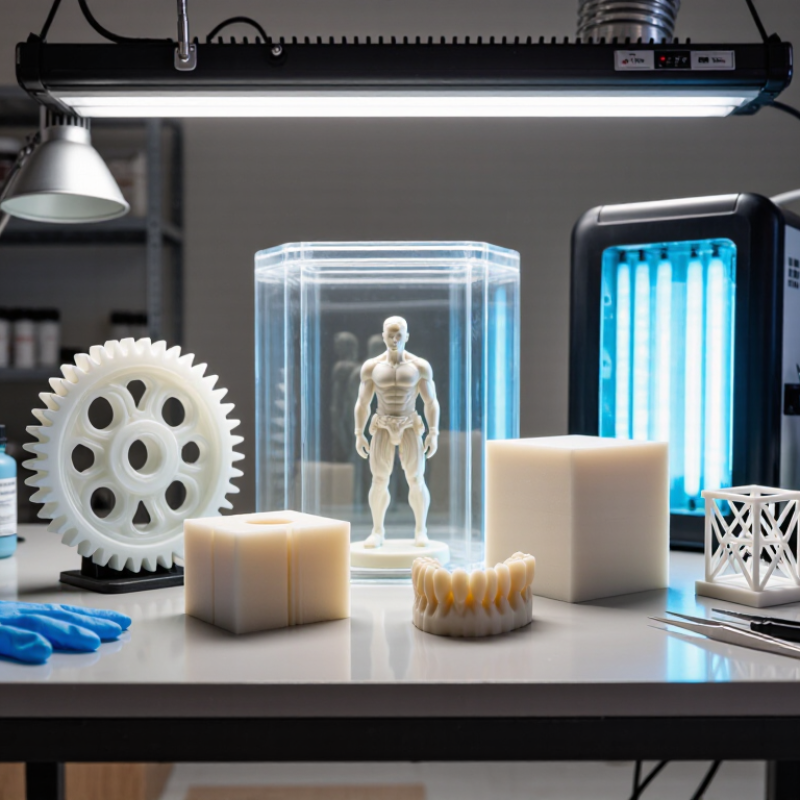
Epoxy resin 3D printing uses liquid, light-sensitive resin to build objects layer by layer. A UV laser, projector, or masked screen cures each layer. The resin usually contains epoxy-related polymers, reactive diluents, pigments, and photoinitiators. It is not ordinary epoxy. Traditional epoxy hardens after mixing two components, while photopolymer resin cures through controlled light exposure.
The process can produce sharp lettering, smooth curves, and small holes with impressive accuracy. SLA, DLP, and MSLA systems are common options within the seven main resin-printing choices. In a practical test, a 0.05-millimeter layer can show fine surface detail, but exposure settings still change results.
Industry demand supports this interest. The Wohlers Report 2024 valued the global additive manufacturing industry at 20.035 billion dollars in 2023, after 13.5% growth. Fortune Business Insights estimated the 3D-printing materials market at about 2.99 billion dollars that year.
These figures cover broader technologies, not epoxy resin alone, so they should not be treated as direct resin-market proof. That distinction is easy to miss. ASTM and ISO terminology also classify materials by process, not simply by marketing names.
Users should check technical data sheets for tensile strength, heat resistance, shrinkage, and post-curing requirements.
Ventilation, gloves, eye protection, and complete curing remain essential because uncured resin can irritate skin. A glossy print may look finished. It may not be.
When comparing epoxy resin 3D printing options, I start with the final part, not the advertised resolution. A display model needs different properties from a heat-exposed fixture. Define the load, temperature, surface finish, and expected service life before choosing resin.
Check the printer’s curing wavelength, resin viscosity, build volume, and layer-height range. A resin may look suitable but cure unevenly on incompatible equipment. I examine technical data sheets for tensile strength, elongation, heat resistance, shrinkage, and chemical compatibility. These figures help, but they are not the whole story. Actual results depend on exposure settings, washing, support placement, and post-curing.
Test a small calibration part before committing to a large print. Measure holes, walls, corners, and warping with simple calipers. Inspect the surface under angled light. I once trusted a smooth sample and missed brittle supports that failed during removal. That mistake changed my evaluation process. Toughness matters.
Post-processing deserves equal attention. Confirm the recommended cleaning method, curing duration, and ventilation requirements. Read the safety data sheet, and use suitable gloves and eye protection. Compare waste, failed-print frequency, printing speed, and replacement-part costs, not just the resin price. A reliable option should produce repeatable parts across several test runs, although perfect consistency is difficult in ordinary workshop conditions.
This chart compares seven common resin categories using a normalized 1–5 performance index. Higher scores indicate stronger suitability for the listed criterion. Actual results vary with printer settings, curing conditions, and material specifications.
General-purpose resin is a balanced choice for prototypes, while tough resin is better for impact resistance. High-temperature resin suits heat-exposed parts, flexible resin supports bendable components, and castable resin is designed for investment casting. Water-washable resin simplifies cleaning, whereas biocompatible resin should only be used when the material has the required regulatory validation.
Choosing among seven leading epoxy resin 3D printing options depends on the part’s real working conditions. Standard rigid epoxy suits brackets, housings, and display models requiring sharp edges. Tough epoxy handles repeated impacts better, making it useful for clips, hinges, and functional prototypes. Flexible epoxy bends under moderate pressure, although thin sections may tear sooner than expected.
High-temperature epoxy supports molds, fixtures, and components exposed to controlled heat. Castable epoxy can produce detailed patterns for professional casting workflows, but burnout results depend heavily on curing and furnace control.
Clear epoxy reveals internal channels and lighting effects, yet slight yellowing can appear after prolonged exposure to ultraviolet light. Ceramic-filled epoxy offers greater stiffness and a smoother surface, though its abrasive particles may shorten equipment life.
From practical testing, layer exposure, resin temperature, and post-curing time change the final result noticeably. A small calibration print should check dimensional accuracy before producing a large part. I usually measure a 20-millimeter cube, inspect its corners, and test a thin wall. Resin handling also requires ventilation, protective gloves, and careful waste management. These details are easy to overlook. My own early prints were over-cured, brittle, and visibly warped. That mistake showed why manufacturer data should guide settings, while actual workshop testing confirms whether the material fits the job.
The best epoxy resin 3D printing option depends on the application, not the machine’s advertised speed.
SLA suits dental models, casting patterns, and detailed prototypes because its laser traces fine features accurately. DLP works well for small production batches, where an entire layer cures at once. LCD or MSLA printing is practical for affordable prototypes, miniature parts, and classroom development, although screen life and resin uniformity can affect results. Continuous photopolymer printing fits taller prototypes and repeated parts because it reduces layer pauses. Its surface quality can be excellent, but support removal still needs patience.
Two-photon polymerization serves microfluidic devices, optical structures, and research components requiring extremely small features. It is precise, but usually slow and expensive. Volumetric resin printing suits complex internal geometries because it can cure an object within a vat, potentially reducing support structures. The method remains less accessible, and process control is demanding. Photopolymer material jetting is useful for visual prototypes, anatomical models, and assemblies needing multiple material behaviors. However, resin waste and post-processing may be overlooked.
The choice is rarely obvious.
The Wohlers Report 2024 valued the global additive manufacturing industry at approximately 20.0 billion US dollars in 2023, with resin-based systems supporting medical, dental, and industrial growth. Industry forecasts from SmarTech Analysis also identify photopolymer systems as a strong segment, though estimates vary by definition.
Tips: Match resin toughness, heat resistance, and biocompatibility to the final use. Test a small geometry first. A glossy part can still fail under heat, impact, or repeated handling.
Choosing among the seven best epoxy resin 3D printing options starts with the part’s real job. Standard resin suits display models and small prototypes. Tough resin handles clips, hinges, and repeated handling better. Flexible resin works for grips, seals, and soft-touch components. Castable resin is useful for detailed patterns before casting. High-temperature resin fits parts exposed to heat. Clear resin reveals internal shapes, while filled resin improves stiffness and surface feel.
Check the printer’s wavelength, resin viscosity, and recommended exposure range before buying. A resin may sound strong but still crack around thin holes. Measure wall thickness, too. For a functional bracket, I usually print a small test piece first, using the same layer height and orientation planned for production. This exposes warping, weak supports, and unexpected brittleness early. Small tests save material.
Think about cleaning and post-curing time. Some parts feel solid after washing but remain weak without complete curing. Inspect corners under bright light. Look for cloudy areas, tackiness, or tiny support scars. I once selected a rigid resin for a snap-fit enclosure, and the first version failed because the tabs had no flex allowance. That mistake changed my process. I now compare strength, accuracy, heat resistance, finish, and handling safety in a simple test chart. Manufacturer data matters, but your geometry matters more. A resin that performs well in a flat sample may disappoint in a tall, hollow model. Check ventilation and follow the supplier’s handling instructions throughout the workflow.
| Resin Option | Best Application | Typical Tensile Strength | Typical Elongation at Break | Typical Heat Deflection Temperature | Recommended Layer Height | Post-Processing Requirement | Main Advantages | Key Limitations | Project Suitability |
|---|---|---|---|---|---|---|---|---|---|
| 1. Standard Epoxy-Based Resin | General prototypes, display models, small functional parts and design verification | 30–60 MPa | 3–8% | 45–65°C | 0.025–0.10 mm | Wash with the specified solvent, dry completely and UV-cure according to the material instructions | Good surface finish, fine detail reproduction and broad printer compatibility | Can be brittle under impact and may soften at elevated temperatures | ★★★★★ Best all-purpose choice |
| 2. Tough or Impact-Resistant Resin | Housings, clips, snap-fits, enclosures and parts exposed to repeated handling | 35–65 MPa | 10–30% | 50–75°C | 0.05–0.10 mm | Standard cleaning and post-curing; controlled curing helps preserve impact resistance | Higher impact resistance and lower fracture risk than standard formulations | Usually less rigid and less heat-resistant than engineering or high-temperature materials | ★★★★★ Best for functional prototypes |
| 3. High-Temperature Resin | Heat-resistant tooling, molds, fixtures, ducts and parts used near elevated temperatures | 40–75 MPa | 2–8% | 120–200°C | 0.025–0.10 mm | Thorough washing and carefully controlled UV or thermal post-curing may be required | Highest thermal resistance among common photopolymer resin categories | Often more brittle, slower to print and more demanding to post-process | ★★★★☆ Best for thermal applications |
| 4. Flexible or Elastic Resin | Gaskets, grips, seals, soft-touch components and parts requiring repeated bending | 1–15 MPa | 50–200% | 35–60°C | 0.05–0.15 mm | Use careful washing and moderate post-curing to avoid excessive stiffness or surface tack | High flexibility, rubber-like behavior and good vibration absorption | Lower dimensional stability, lower heat resistance and more difficult support removal | ★★★★☆ Best for elastic parts |
| 5. Castable Resin | Jewelry patterns, investment casting patterns and small precision casting models | 15–40 MPa | 2–8% | Typically below 60°C before burnout | 0.025–0.05 mm | Requires a validated burnout schedule and compatible investment material; residual ash must be minimized | Designed to burn out with limited expansion and can reproduce very fine details | Not intended for durable end-use parts and requires casting-specific equipment and procedures | ★★★★☆ Best for investment casting |
| 6. Water-Washable Resin | Education, hobby projects, rapid prototyping and workshops that prefer simplified cleaning | 25–50 MPa | 3–12% | 45–65°C | 0.05–0.10 mm | Wash with clean water, dry fully and complete the recommended UV post-cure; contaminated water requires proper disposal | Convenient cleanup, low solvent use and good detail for general models | May be more moisture-sensitive and more brittle than specialized engineering formulations | ★★★☆☆ Best for convenient cleanup |
| 7. Certified Biocompatible Resin | Dental guides, surgical models, orthodontic models and other regulated applications | 40–80 MPa | 2–10% | 50–80°C | 0.025–0.10 mm | Requires validated washing, curing and handling procedures specified by the material documentation | Can provide controlled performance for approved professional or medical workflows | Only suitable for the exact certified indication; formulation, printer and curing workflow must be validated together | ★★★★☆ Best for regulated applications |
© 1999-2025 The Lincoln Electric Company