Choosing the best robotic training system in China depends on what learners must do after class. A university lab may need open programming tools and safe access to robot arms. A factory may value repeatable practice, quick changeovers, and realistic fault scenarios. The same system will not serve both equally well. That is the first point worth examining.
Robotics pioneer Joseph Engelberger is often quoted as saying, “I can’t define a robot, but I know one when I see one.” His remark is playful, yet it points to a practical challenge: a convincing training system must connect the screen to the machine. Look for clear task sequences, responsive controls, visible safety zones, and feedback learners can use. A trainee should be able to set a motion path, notice a collision warning, and understand what to adjust next. Small details matter.
China offers a wide range of training platforms, from simulation-based courses to integrated cells with real robotic arms. Comparing them requires more than counting features or accepting a polished demonstration. Check the curriculum, equipment support, instructor experience, and opportunities for supervised practice. Ask how progress is measured. Ask what happens when a sensor gives an unexpected reading. These questions are easy to overlook. No single product can be called the best without a defined learner, budget, and application. This guide evaluates those trade-offs and explains how to select robotic training that fits a real learning environment.
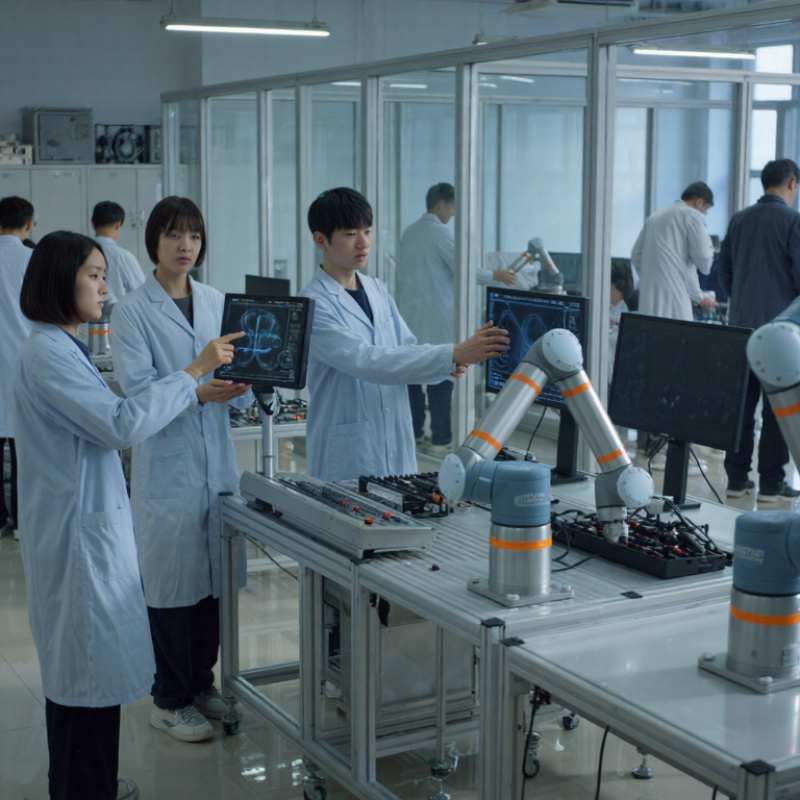
A robotic training system is a setup that lets people practise operating or maintaining a robot in a controlled environment. It may include a robot arm, a controller, training software, and safety equipment. The goal is practical learning, not simply watching a demonstration. A trainee can move a tool toward a marked point, adjust its path, and see how small changes affect the result. That feedback matters.
In a typical session, software presents a task and records the trainee’s movements. Sensors track the robot’s position and speed, while the controller translates commands into motion. If the path is too fast or inaccurate, the system can flag the issue or pause the exercise. Trainers can review performance and repeat the same task under similar conditions. Repetition helps.
Some systems use virtual models before trainees work with physical equipment. This can make early practice less intimidating, though a simulation may not capture every vibration, delay, or awkward reach. Real-world practice still matters. A useful training setup should match the robot and tasks people will encounter, offer clear feedback, and make safe procedures part of each exercise. The “best” system is not automatically the most complex; it is the one learners can use consistently. I would still check whether its exercises reflect actual workplace needs, because polished demonstrations can hide gaps.
A capable robotic training system is more than a robot arm. It combines a controller, interchangeable end effectors, sensors, safety equipment, and programming software. Together, these components let learners move from basic jogging to repeatable pick-and-place tasks. Small details matter: a loose cable or poorly calibrated gripper can make a simple exercise frustrating.
The International Federation of Robotics’ World Robotics 2024 report recorded 276,288 industrial robot installations in China in 2023, representing 51% of global installations. That scale makes practical training relevant, but equipment alone cannot teach sound judgment. Look for systems that expose controller settings, provide clear safety boundaries, and support realistic tasks such as sorting parts on a workbench. Sensors should show how the robot responds when an object shifts. Software should allow learners to test, review, and correct programs. No kit is perfect; integration between hardware and lessons can still be uneven.
Tips: Before choosing a system, check that learners can safely adjust speed, tool position, and sensor thresholds. Ask for a sample lesson and assessment rubric. A short demo helps reveal whether setup is genuinely clear—or merely looks simple in a brochure.
A useful comparison starts with the work learners must perform, not the equipment catalogue. Check whether lessons cover setup, coordinate systems, tool paths, fault recovery, and routine maintenance. A system that teaches only clean, repeatable demonstrations may leave trainees unprepared for a real workshop. Ask to see a sample lesson and its assessment criteria.
Local support matters. Confirm that manuals, interfaces, and instructor materials are available in clear Chinese, and ask how quickly replacement parts and technical help can be provided. Small details count. Test the simulator and physical equipment with the same task, such as moving a gripper around a marked fixture. Compare programming time, error feedback, and how easily learners can repeat the exercise. Also review safety features, access controls, and options for connecting sensors or production software. Compatibility claims deserve a practical check.
Measure total cost across setup, training, maintenance, and future course updates, rather than comparing purchase prices alone. Ask instructors to trial the system and record where students hesitate; their notes can reveal gaps that a polished demonstration hides. I would not treat one successful trial as proof of long-term value. Results depend on teaching quality, class size, and how closely exercises match local factory needs. That uncertainty is worth documenting.
China’s training options range from physical robot workcells to simulation-based courses. The right choice depends on the skills being taught, not just the equipment.
The International Federation of Robotics reported 276,288 industrial robot installations in China in 2023, about 51% of global installations. That figure describes industrial deployment, not training-system sales. Still, it shows why practical robot skills matter.
Physical workcells let learners practise calibration, safe movement, tool changes, and basic fault recovery on real equipment. Simulation and offline-programming systems allow students to test paths on a screen before using a robot.
Collaborative-robot courses focus on hand-guided tasks and shared workspaces, while mobile-robot training covers navigation, sensors, and fleet coordination. Some classes combine these formats. That helps.
Providers generally include vocational colleges, universities, equipment integrators, and simulation-software suppliers. Colleges may offer structured lessons and repeatable practice; integrators can build application-specific cells.
Buyers should check instructor experience, curriculum updates, maintenance support, and whether learners get enough hands-on time. A polished digital twin is useful, but it cannot fully reproduce a loose connector or a badly placed workpiece.
Training cells can also be too tidy. That limitation deserves attention.
In China, robotic training systems are moving from specialist labs into vocational classrooms, hospital simulation rooms, and industrial training centers. Their value is practical: learners can rehearse repeatable tasks, receive performance feedback, and try again without interrupting live operations. A trainee might guide a robot arm through pick-and-place movements, then review timing, accuracy, and missed steps. This makes progress visible. Not automatic.
Adoption varies widely. Large institutions may fund integrated simulators; smaller centers often need portable equipment and local support. Curriculum fit matters as much as hardware. Instructors need time to turn system feedback into useful coaching, while data practices should be clear and responsible. Poorly maintained sensors or unrealistic scenarios can weaken trust. That part is easy to underestimate. Future systems may favor modular designs, Chinese-language resources, safer collaboration practice, and links to real equipment. Still, access, instructor training, and reliable evaluation remain uneven. Claims of rapid transformation deserve scrutiny.
Tips: Define the target task, test the system with instructors, and compare results against a simple baseline. Check setup time, repair access, and whether feedback explains errors plainly. A small pilot can reveal awkward steps early.
© 1999-2025 The Lincoln Electric Company