

China Best Robotic Welding Cells Manufacturers
China has become a major production base for robotic welding cells, supported by strong automation demand and a broad manufacturing ecosystem. The International Federation of Robotics reported 276,288 industrial robot installations in China during 2023. That represented approximately 51% of global installations. The same report identified China as the world’s largest robot market. These figures show scale, but scale does not automatically prove welding quality.
A reliable supplier must connect robot performance with practical factory results. Buyers should examine torch accessibility, weld repeatability, positioner accuracy, fume extraction, programming time, and after-sales response. A typical cell may combine a six-axis robot, dual-station positioner, welding power source, safety fencing, sensors, and offline programming software. Small details matter. Cable routing can affect maintenance. Fixture rigidity can influence distortion. Operator training can determine whether promised cycle times become reality.
Industry forecasts from MarketsandMarkets and Grand View Research indicate continued growth in robotic welding equipment, driven by labor shortages, automotive production, heavy machinery, and stricter consistency requirements. However, market forecasts are not purchase guarantees. Some supplier claims remain difficult to verify without factory acceptance tests, sample welds, and documented production data. This guide evaluates China’s best robotic welding cells manufacturers through engineering capability, certification practices, customization experience, integration quality, and lifecycle support. It also considers standards such as ISO 10218 and ISO 13849, where applicable. The goal is practical judgment, not a simple ranking. A polished showroom may impress, but a stable weld at 2 a.m. matters more.
What Are Robotic Welding Cells and How Do They Work?
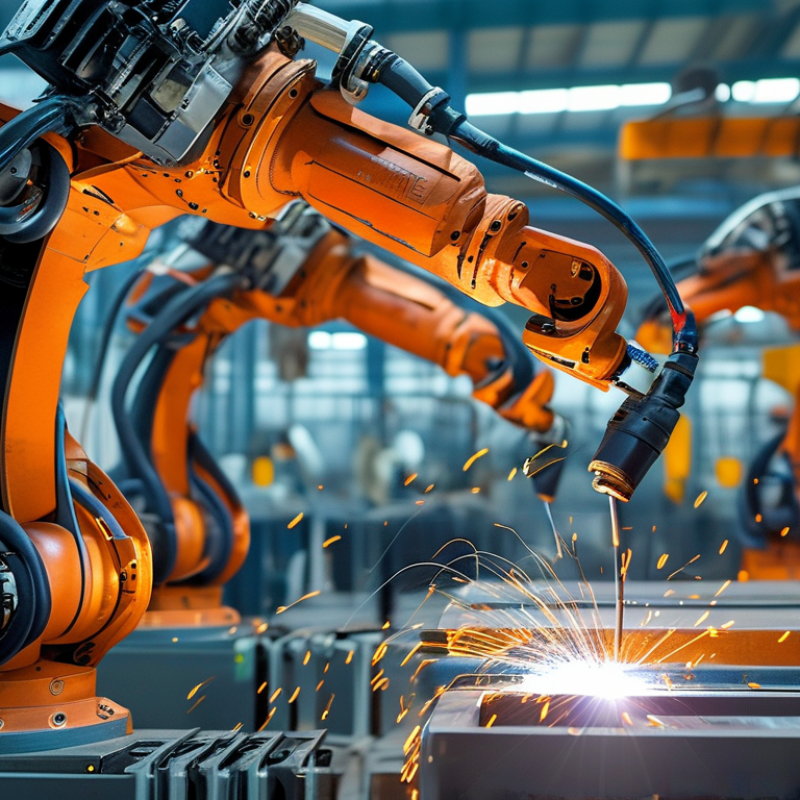
Robotic welding cells combine a programmable industrial robot with a welding power source, positioner, fixtures, sensors, and a guarded workspace. The robot follows programmed paths while the positioner turns the workpiece into a better welding angle. Sensors can detect joint location, arc conditions, and part movement.
The operating cycle is practical. An operator loads the fixture, closes the safety gate, and starts the program. The controller checks permissions before ignition. The robot then moves the torch, controls travel speed, and maintains the programmed distance. A positioner may rotate the component continuously. After welding, the operator inspects the bead and removes the part.
According to the International Federation of Robotics’ World Robotics 2024 report, 541,302 industrial robots were installed worldwide in 2023. This scale reflects wider automation demand, including welding applications. Welding cells can improve repeatability, reduce exposure to fumes, and support stable production rates. However, automation is not magic. Poor fixturing still creates distortion, and incorrect parameters can produce weak joints. In my experience, cycle-time promises often overlook loading, inspection, and maintenance. The International Organization for Standardization’s ISO 10218 framework also emphasizes robot safety and risk reduction. For buyers comparing Chinese robotic welding cell manufacturers, practical trials, documentation, spare-part access, and operator training deserve equal attention. A flawless demonstration proves little without production data.
China Best Robotic Welding Cells Manufacturers - What Are Robotic Welding Cells and How Do They Work?
| Evaluation Dimension | Typical Industry Data | How It Works or Why It Matters | Recommended Selection Consideration |
|---|---|---|---|
| Basic Definition | Integrated robotic welding system with a robot, welding power source, fixture, controller, safety enclosure, and related software | The robot moves the welding torch along a programmed path while the fixture holds and positions the workpiece. | Check whether the complete cell includes all required components rather than only the robot arm. |
| Common Welding Processes | Gas Metal Arc Welding (GMAW/MIG), Gas Tungsten Arc Welding (GTAW/TIG), Flux-Cored Arc Welding (FCAW), and laser welding | GMAW and FCAW are widely used for steel fabrication; GTAW is selected for controlled, high-quality welds; laser welding is suited to specific high-speed and low-distortion applications. | Match the process with the material, thickness, joint design, required appearance, and production rate. |
| Robot Configuration | Usually a six-axis articulated robot for three-dimensional torch orientation | Six independently controlled axes allow the torch to approach joints from different angles and maintain the required welding position. | Use six-axis equipment when the product has complex joints or requires multiple welding orientations. |
| Typical Robot Payload | Approximately 6–20 kg for many arc-welding applications | Payload capacity must support the torch, cable package, wire feeder, dress pack, and any auxiliary tooling. | Calculate the complete wrist load, not just the torch weight, and include a safety margin. |
| Typical Working Reach | Approximately 1.4–2.6 m, depending on robot size and cell layout | Reach determines whether the robot can access every weld without excessive repositioning or interference. | Use a digital reach simulation or physical layout study before finalizing the cell. |
| Position Repeatability | Common industrial robot specifications are approximately ±0.02–0.08 mm | Repeatability describes how closely the robot returns to a programmed position under comparable operating conditions. | Remember that fixture accuracy, part variation, thermal distortion, and wire quality also affect weld consistency. |
| Welding Current Range | Common arc-welding power sources cover approximately 50–500 A, depending on the process and duty rating | Higher current supports larger wire diameters and thicker materials, while lower current is used for thinner sections and controlled heat input. | Select the power source according to material thickness, wire diameter, duty cycle, and joint requirements. |
| Wire Diameter | Common solid or flux-cored wire diameters include approximately 0.8, 1.0, 1.2, and 1.6 mm | Wire diameter affects deposition rate, current requirements, penetration, and suitability for different joint sizes. | Confirm compatibility among the wire feeder, contact tip, liner, welding program, and consumables. |
| Typical Welding Speed | Approximately 3–15 mm/s for many conventional arc-welding operations; higher speeds may be possible in specialized applications | Welding speed influences heat input, bead size, penetration, and cycle time. | Validate the speed through welding trials because material, joint type, shielding gas, and current significantly affect results. |
| Shielding Gas | Argon, carbon dioxide, or argon-based mixtures are commonly used for arc welding | Shielding gas protects the molten weld pool from atmospheric contamination and influences arc stability and bead appearance. | Specify gas composition, flow rate, purity, and supply method for stable production welding. |
| Positioning Equipment | Single-axis positioner, two-axis positioner, headstock-tailstock unit, or rotary table | A positioner rotates or tilts the workpiece so the robot can weld in more favorable positions and reduce non-welding travel. | Choose the rated load, rotation speed, accuracy, and work envelope based on the largest product. |
| Fixture Function | Locates, supports, and clamps parts with repeatable datum references | A rigid and repeatable fixture reduces dimensional variation and helps keep the joint within the robot's programmed path. | Include access for the torch, clamping clearance, fume removal, cleaning, and quick part loading. |
| Seam-Finding Methods | Touch sensing, through-the-arc tracking, laser seam tracking, or mechanical probing | These systems detect joint location or deviation and compensate for part-positioning errors before or during welding. | Use sensing when parts vary, fixtures cannot control all tolerances, or long welds require active correction. |
| Control and Programming | Robot controller with teach pendant, offline programming capability, weld schedules, and safety logic | The controller synchronizes robot motion, welding parameters, positioner movement, sensing, and interlocks. | Assess program backup, user access levels, simulation support, data logging, and operator training. |
| Cell Cycle Time | Often measured from part loading to unloading; actual values may range from under 1 minute to several minutes | Cycle time includes welding, robot travel, positioner movement, part loading, inspection, wire cutting, and occasional cleaning. | Compare complete cycle time rather than arc-on time alone when calculating production capacity. |
| Arc-On Time | Commonly targeted at approximately 40–70% of the total automated cycle in well-balanced applications | Arc-on time is the proportion of the cycle during which the robot is actively welding. | Increase arc-on time through suitable fixtures, dual-station layouts, optimized paths, and reduced handling delays. |
| Production Capacity | Determined by cycle time, shifts, uptime, scrap rate, changeover time, and required availability | Robot speed alone does not define output; material handling and process stability can become the limiting factors. | Use a capacity model based on actual product mix and planned operating hours. |
| Safety Protection | Perimeter guarding, interlocked access doors, emergency stops, safety-rated controls, and welding screens | These systems restrict access to moving equipment, welding arcs, sparks, hot surfaces, and other hazards during automatic operation. | Design the cell according to applicable local occupational safety and machinery requirements. |
| Fume and Spatter Management | Source-capture extraction, fume hoods, anti-spatter systems, torch cleaning, and scheduled consumable maintenance | Extraction removes welding fumes, while cleaning and anti-spatter measures help preserve torch performance and weld quality. | Provide ventilation capacity suitable for the process, materials, production rate, and enclosure design. |
| Quality Monitoring | Visual inspection, weld parameter monitoring, current and voltage recording, seam tracking feedback, and optional vision inspection | Monitoring helps identify deviations in arc stability, travel speed, wire feed, weld position, and other process variables. | Define acceptance criteria and traceability requirements before selecting inspection hardware. |
| Suitable Materials | Carbon steel, stainless steel, aluminum, and selected alloys when the equipment and process are properly configured | Each material requires appropriate wire, shielding gas, polarity, heat input, cleaning method, and welding parameters. | Request representative sample welds using the actual material, thickness, and joint design. |
| Typical Applications | Frames, brackets, storage equipment, agricultural components, construction machinery parts, pressure-related fabrications, and general metal assemblies | Robotic cells are most effective for repeatable products with sufficient production volume and consistent joint geometry. | Prioritize parts with stable fixtures, repeated weld paths, and predictable incoming tolerances. |
| Maintenance Requirements | Regular inspection of torch consumables, liners, contact tips, cables, wire feeders, fixtures, positioners, sensors, and safety devices | Preventive maintenance reduces unplanned downtime and helps maintain consistent arc behavior and positioning accuracy. | Obtain a documented maintenance schedule, spare-parts list, and service-response plan. |
| Key Selection Criteria | Weld quality, repeatability, cell footprint, throughput, safety, flexibility, serviceability, integration capability, and total cost of ownership | A suitable cell balances technical performance with installation, training, maintenance, energy, consumable, and labor costs. | Evaluate the complete life-cycle cost and verify performance with application-specific testing. |
Note: The figures shown are typical industry ranges for orientation only. Actual performance depends on the workpiece, joint design, material, welding process, fixture accuracy, software configuration, operating conditions, and applicable safety requirements.
Related Posts
-
Top 10 Robotic Welding Solutions for Efficient Manufacturing?
-

How to Optimize Robotic Welding Cells for Maximum Efficiency?
-
2026 Top Trends in Robotic Welding Technology What to Expect?
-
Unlocking the Future of Robotic Welding Training at the 138th Canton Fair in China 2025
-
How to Master Robotic Spot Welding: Techniques and Best Practices
-
How to Choose the Best Robotic Welding Cells for Your Needs?