
Choosing an Oilless Reciprocating Compressor requires more than comparing horsepower and purchase prices. The right model must match air demand, pressure requirements, duty cycle, and operating conditions. A compressor that looks efficient on paper may struggle in a dusty workshop or during repeated start-stop cycles.
Begin with the application. Medical equipment, laboratory instruments, food packaging, and electronics production often require clean compressed air. In these environments, oil-free operation can reduce contamination risks and simplify maintenance planning. However, “oilless” does not mean maintenance-free. Pistons, seals, valves, filters, and cooling components still need regular inspection.
Air quality matters. Check the manufacturer’s technical documentation and confirm whether the system meets the required ISO 8573-1 air-quality class. Review the rated flow at working pressure, not only the advertised maximum airflow. A technician should also examine receiver size, noise levels, heat dissipation, electrical compatibility, and replacement-part availability.
Fit matters most.
Real operating measurements are valuable. Record peak demand, average demand, daily running hours, and pressure fluctuations before making a decision. These details expose weaknesses that catalog specifications may hide. No selection method is perfect. Even experienced buyers can underestimate future production changes or ambient heat.
A dependable choice balances performance, lifecycle cost, service access, and workplace comfort. Ask suppliers for test conditions, warranty limitations, and clear maintenance intervals. When possible, compare two or three models under similar operating assumptions. The best Oilless Reciprocating Compressor is not always the largest or cheapest unit. It is the one that delivers stable, clean air without creating avoidable problems later.
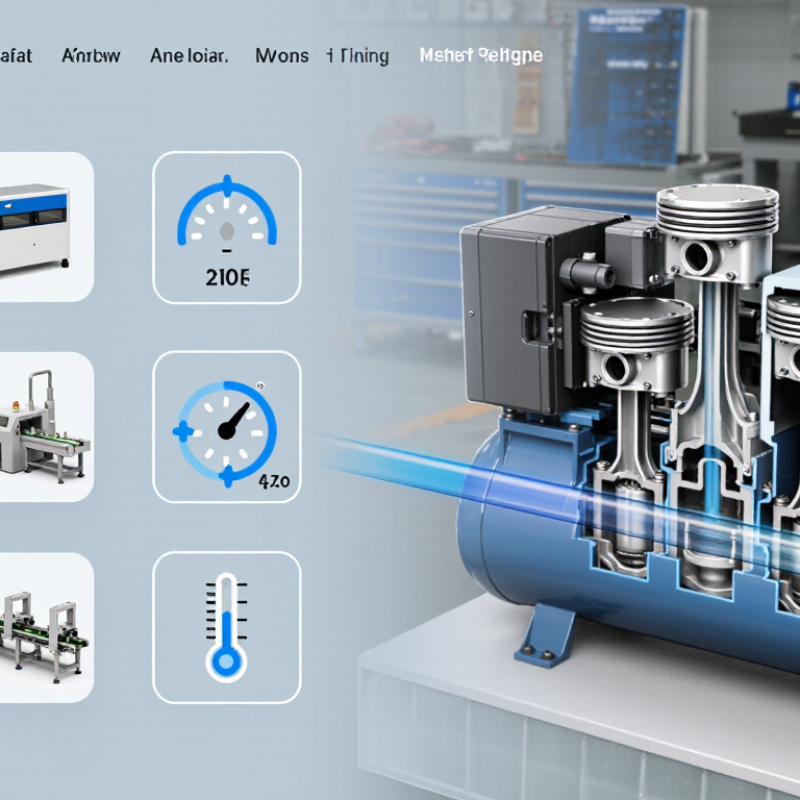
Start by defining air demand in free air delivery (FAD), not piston displacement. FAD represents air delivered under standardized inlet conditions. ISO 1217 provides the testing framework for compressor capacity and performance. Record each tool’s flow requirement, then add realistic demand from simultaneous operation. A workshop using 500 L/min today may need 650 L/min during cleaning or production peaks. Pressure matters too. Many pneumatic systems operate effectively between 7 and 10 bar, but higher pressure can increase energy use. The U.S. Department of Energy reports that compressed-air leaks may waste 20–30% of compressor output in poorly maintained systems.
Duty cycle is easy to overlook. An oilless reciprocating compressor may tolerate intermittent loading, but continuous operation can increase heat, wear, and maintenance frequency. Check the manufacturer’s rated duty cycle against your measured load pattern. A 60% duty cycle means six minutes running in ten, not occasional use across an entire shift. Experience shows that this distinction prevents undersized selections. Still, real sites are rarely perfect. Temperature, clogged filters, and pressure drops can change the result.
Tips: Measure pressure at the point of use, not only at the receiver. Log FAD demand for several working days. Leave moderate capacity margin, but avoid excessive oversizing. The DOE sourcebook recommends leak surveys and regular maintenance because small leaks become expensive continuously. I would also recheck the calculation after installation; initial assumptions are often wrong.
How to Choose an Oilless Reciprocating Compressor?
For sensitive production, “oilless” is only the starting point. Specify air purity using ISO 8573-1 Class 0 requirements. Class 0 is stricter than Class 1, but it is not one universal oil limit. The user must define the maximum total oil concentration. State the value clearly, such as a limit below 0.01 mg/m³, when the process demands it. Confirm whether the limit applies at the compressor outlet, dryer outlet, or point of use.
An oilless reciprocating compressor keeps lubricating oil away from the compression chamber. However, oil can still enter from crankcase seals, intake air, worn components, or downstream equipment. Check the piston materials, sealing design, cooling method, and expected service interval. Ask for factory test data under stated pressure, temperature, and flow conditions. A clean outlet at the factory may not remain clean after hot piping, storage tanks, or poorly maintained filters. That detail is often missed.
Tips: Define Class 0 with a measurable oil limit and sampling location. Test oil aerosol and vapor according to applicable ISO 8573 methods. Install suitable filtration, dryers, and clean receivers. Inspect seals before performance declines. Keep a written maintenance record. Small leaks matter. I would also challenge vague claims such as “100% oil-free.” They sound reassuring, but they need evidence, operating limits, and repeatable test results.
When choosing an oilless reciprocating compressor, compare useful air delivery, not piston displacement alone. ISO 1217 FAD provides a common reference for compressor capacity. It reports the air delivered under defined inlet and discharge conditions. Ask suppliers for certified FAD values at your required working pressure.
Do not compare catalog numbers blindly. A compressor rated at 10 bar may deliver much less air at 12 bar. Check inlet temperature, humidity, cooling-water conditions, and test pressure. Installation altitude also matters.
In a workshop evaluation, record pressure, flow, motor input, and running temperature after the unit reaches stable operation. Small measurement errors can change the ranking.
Efficiency needs more than a single percentage. Compare specific power, such as kilowatts per cubic metre per minute of FAD. Lower specific power usually means lower energy use for the same air output. However, include standby losses, unloading cycles, dryers, and cooling equipment.
An oilless design may reduce contamination concerns, yet its maintenance schedule still affects long-term efficiency. Inspect valve condition and cylinder wear during trials. Real results can be untidy.
Our first comparison once favored the smaller compressor, but frequent cycling increased its energy use. Recheck the duty cycle. Pay attention to noise, vibration, service access, and the compressor’s ability to maintain stable FAD during peak demand.
How to Choose an Oilless Reciprocating Compressor?
Sizing the motor starts with the real air demand, not the tool’s advertised maximum. Measure flow in cubic feet per minute at the required pressure. Add a practical margin of 15 to 25 percent for leaks, cold starts, and pressure loss. A motor that runs continuously near its limit may overheat, even when the pressure gauge looks normal. Check voltage, altitude, starting current, and the manufacturer’s rated duty cycle before selecting the motor.
Duty cycle changes receiver sizing. Continuous applications need stable airflow, strong ventilation, and a receiver that smooths demand without hiding an undersized compressor. Intermittent tools can use a larger receiver to reduce motor starts. Too large, however, may delay pressure recovery and encourage long, hot cycles. I have seen this mistake in otherwise careful installations. The receiver should also include a drain and a pressure rating suitable for the complete system.
Cooling deserves equal attention. Keep clear airflow around the compressor, and avoid placing it beside a wall or heat-producing equipment. In warm rooms, an aftercooler may lower outlet temperature and reduce moisture problems. Monitor discharge temperature during the longest expected run, not during a short test. A temperature alarm helps, but it does not replace clean intake filters and routine inspection. My calculations are sometimes optimistic; actual demand should be verified after installation.
Typical selection points for matching motor size, receiver capacity, and cooling airflow to continuous or intermittent duty. Final sizing should be verified against actual air demand, pressure, ambient temperature, and manufacturer specifications.
Reading the chart: Intermittent-duty applications can use a smaller motor with a larger receiver to absorb short demand peaks. Continuous-duty operation requires adequate cooling airflow and a compressor package rated for sustained operation rather than relying only on receiver storage.
When choosing an oilless reciprocating compressor, verify noise with measured evidence, not brochure claims. A practical audit should record sound pressure levels at defined microphone positions, load conditions, and operating distances. ISO 2151 specifies methods for determining noise emission from compressors and vacuum pumps. Ask for the test environment, uncertainty, and A-weighted results.
Do not trust showroom silence.
A common mistake is comparing decibel values without checking test conditions. A 3 dB increase represents roughly twice the sound energy, although perceived loudness does not double.
The U.S. Department of Energy and Compressed Air Challenge guidance indicate that energy can represent about 70% of a compressed-air system’s lifecycle cost. Therefore, calculate annual cost using actual power, operating hours, electricity tariffs, pressure, and duty cycle.
Use this practical model:
purchase price, installation, energy, scheduled maintenance, repairs, downtime, and disposal.
Oilless designs remove oil-management tasks, but they still require valve checks, piston-ring inspection, intake-filter replacement, and cooling-system cleaning. Maintenance intervals should reflect dust, humidity, starts per hour, and load fluctuations.
Small details matter.
A perfect spreadsheet can still mislead. Add a sensitivity check for electricity prices and unexpected downtime. Compare five- to ten-year ownership costs, not only the initial quotation.
For credible decisions, retain ISO 2151 test records and maintenance assumptions with the calculation.
© 1999-2025 The Lincoln Electric Company