

China Top Marine Generator Sets Manufacturers?
Choosing among China’s top Marine Generator Sets manufacturers requires more than comparing prices or brochure power ratings. Buyers must examine engineering depth, production consistency, service coverage, and evidence from real operating environments. A generator that performs well at a factory test may behave differently inside a humid engine room, under unstable loads, or during extended port operations.
This guide evaluates leading Chinese manufacturers through practical and professional criteria. It considers engine and alternator quality, fuel efficiency, noise control, cooling design, automation systems, and spare-parts availability. It also reviews testing procedures, certification records, warranty terms, and technical support for international projects. Where applicable, ship classification requirements and regional emission rules deserve close attention. Details matter.
A reliable manufacturer should explain its load-bank testing process clearly. It should provide traceable component information and realistic delivery schedules. Site references can reveal more than polished marketing materials. Interviews with operators may expose maintenance delays, weak documentation, or communication problems that sales teams rarely mention. Those details can affect vessel availability and long-term costs.
No shortlist is perfect. Some manufacturers excel at customization but lack overseas service capacity. Others offer strong production scale but limited experience with specialized vessels. This comparison therefore avoids treating one ranking as absolute. Instead, it helps shipowners, distributors, and marine contractors ask better questions before selecting Marine Generator Sets for demanding applications.
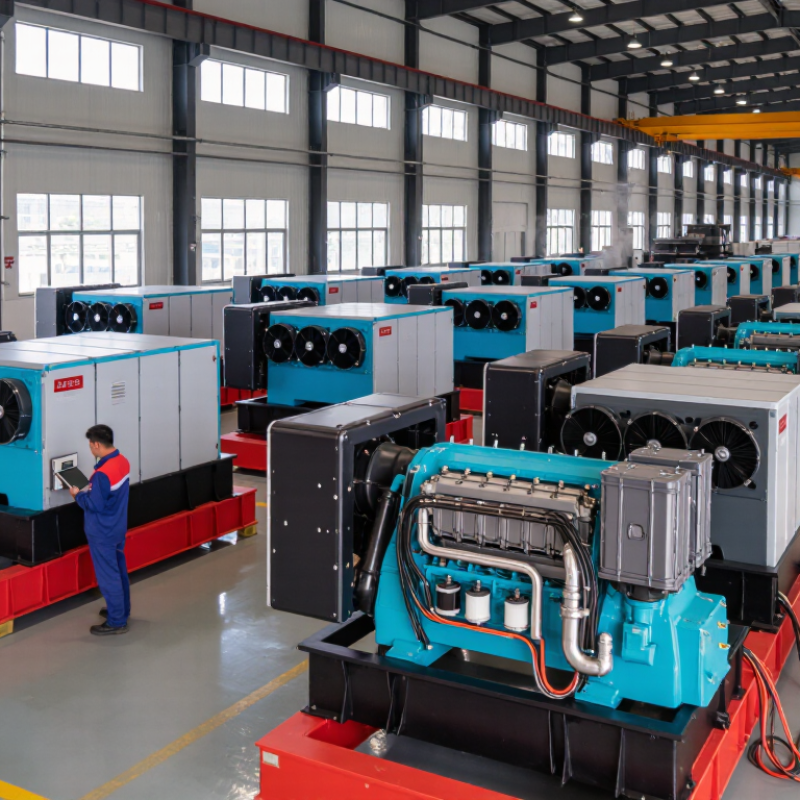
What Are Marine Generator Sets and Why Are They Important?
What Are Marine Generator Sets and Why Are They Important?
Marine generator sets are compact power systems built for vessels. They normally combine a diesel engine, alternator, cooling system, and control panel. Unlike land-based units, they must withstand salt air, vibration, humidity, and limited ventilation. On a working vessel, electricity supports navigation displays, pumps, lighting, refrigeration, and emergency equipment. Power loss is more than an inconvenience. It can affect communication, maneuvering, and crew safety.
Practical buyers should examine output stability, fuel consumption, noise levels, and service access. Classification approval may be essential for commercial or passenger vessels. Reliable manufacturers in China usually provide load-test records, wiring diagrams, maintenance schedules, and corrosion-resistant components. Documentation matters. Manufacturing scale alone proves little. A careful inspection should verify insulation, exhaust routing, seawater cooling, and automatic shutdown protection.
Correct sizing also requires attention to starting loads. A pump or compressor may briefly demand much more power than its running rating. An undersized set can overheat, while an oversized one may operate inefficiently for long periods. There is no flawless installation. Operators should review real operating data after commissioning and adjust maintenance intervals when conditions change. Salt buildup, loose terminals, and neglected filters remain surprisingly common causes of trouble.
China Top Marine Generator Sets Manufacturers? - What Are Marine Generator Sets and Why Are They Important?
| Evaluation Dimension | Typical Marine Generator Set Data | Why It Matters | Recommended Verification Point |
|---|---|---|---|
| Definition | A marine generator set combines an internal-combustion engine, an alternator, control equipment, and auxiliary systems to produce electrical power on board a vessel. | It supplies electricity when the vessel is operating at sea, in port, or when the main propulsion system is unavailable. | Confirm that the unit is designed and tested for marine environments rather than only for land-based standby use. |
| Common Output Range | Approximately 20 to 2,000 kWe is common for many commercial and workboat applications; larger vessels may require customized multi-megawatt systems. | The correct capacity supports hotel loads, navigation equipment, pumps, communication systems, cargo equipment, and emergency services. | Calculate continuous load, starting current, motor loads, reserve capacity, and future electrical demand before selecting the rating. |
| Prime and Standby Operation | Prime-rated sets can operate for extended periods with varying loads. Standby-rated sets are intended for temporary operation during a primary power failure. | Using the wrong rating can cause overload, excessive wear, higher maintenance costs, or insufficient emergency power. | Match the rating to the vessel’s operating profile and the applicable rating standard, such as ISO 8528. |
| Fuel Type | Marine diesel is widely used. Natural gas and dual-fuel systems are also available for vessels with suitable fuel-storage and safety systems. | Fuel selection affects operating cost, emissions, storage requirements, safety procedures, and port compatibility. | Review fuel consumption at 25%, 50%, 75%, and 100% load, as well as fuel quality and onboard storage requirements. |
| Electrical Frequency | Marine systems commonly use 50 Hz or 60 Hz. Engine speeds are often selected to match the required frequency, such as 1,500 rpm at 50 Hz or 1,800 rpm at 60 Hz for four-pole alternators. | Frequency must match the vessel’s switchboard, motors, navigation equipment, and other electrical loads. | Confirm compatibility with the ship’s electrical design before purchase; frequency conversion may require additional equipment. |
| Common Voltage | Low-voltage marine systems commonly use approximately 400 V or 440 V three-phase output, while larger vessels may use medium-voltage distribution. | Correct voltage improves system compatibility and reduces the need for additional transformers or modifications. | Verify rated voltage, phase configuration, neutral arrangement, short-circuit performance, and switchboard compatibility. |
| Marine Construction | Typical features include corrosion-resistant coatings, vibration isolators, flexible connections, compact layouts, seawater cooling circuits, and marine-grade cabling. | Ships experience vibration, humidity, salt spray, restricted installation space, and changing temperatures. | Check enclosure protection, anti-corrosion treatment, mounting design, ventilation, exhaust routing, and cooling-water arrangements. |
| Cooling System | Marine sets generally use closed freshwater cooling with a heat exchanger or keel cooler, with seawater circulated through a separate circuit when applicable. | Reliable cooling prevents overheating and protects engine components in continuous marine operation. | Evaluate heat-exchanger capacity, seawater pump reliability, filters, sacrificial anodes, alarms, and access for cleaning. |
| Emergency Power Function | An emergency generator can support essential systems such as emergency lighting, fire pumps, alarms, navigation-related equipment, communication, and steering-related services, subject to vessel design and regulations. | Emergency power helps protect passengers, crew, cargo, and the vessel during a main-power failure. | Confirm automatic starting time, fuel autonomy, independent installation, emergency switchboard connection, and required testing procedures. |
| Emissions and Compliance | Applicable requirements may include MARPOL Annex VI emission limits, IMO NOx requirements, and local port or emission-control-area rules. | Compliance reduces environmental impact and helps prevent operational restrictions, penalties, or delays. | Request applicable emission certificates, test reports, after-treatment specifications, and documentation for the vessel’s operating area. |
| Standards and Classification | Relevant references can include SOLAS, ISO 8528, ISO 3046, IEC 60092, and requirements from the vessel’s selected classification society. | Standards address performance, safety, testing, electrical installation, environmental conditions, and certification. | Identify the required classification, flag-state, port-state, and project-specific approvals before manufacturing begins. |
| Control and Synchronization | Modern systems may include digital monitoring, automatic start and stop, load sharing, synchronizing, reverse-power protection, overload protection, and remote alarms. | Automation improves power continuity, fuel efficiency, operational awareness, and response to changing loads. | Check communication protocols, alarm history, cybersecurity provisions, redundancy, and compatibility with the vessel management system. |
| Maintenance and Serviceability | Routine work includes oil and filter changes, cooling-system inspection, fuel-system maintenance, battery checks, belt inspection, load-bank testing, and insulation testing. | Accessible maintenance points reduce downtime and help maintain dependable performance. | Evaluate spare-parts availability, service response, technical documentation, crew training, warranty terms, and lifecycle cost. |
| Manufacturer Selection Criteria | Important criteria include marine project experience, documented testing, certification capability, customization, production quality control, delivery reliability, and after-sales support. | A technically suitable generator set still requires dependable integration, commissioning, parts support, and long-term service. | Compare verified references, factory acceptance testing, inspection records, documentation quality, service coverage, and total ownership cost rather than price alone. |
Note: Actual specifications, certifications, ratings, and installation requirements depend on vessel type, flag state, classification requirements, operating area, and the approved electrical design.