Choosing the right automation system can shape a factory’s productivity, safety, and long-term operating costs. Global buyers often compare robotics, conveyor controls, warehouse automation, process control, and software-driven solutions. Each option solves a different operational problem.
A packaging line may need robotic picking, vision inspection, and precise motion control. A distribution center may depend on automated storage, barcode scanning, and fleet management software. These systems can reduce repetitive labor, improve traceability, and deliver more consistent output. However, performance depends on more than impressive specifications. Buyers should examine integration capability, maintenance access, cybersecurity, energy use, training requirements, and local technical support.
This guide presents the top 10 types of automation systems for global buyers. It considers practical use cases, scalability, installation complexity, and measurable return on investment. It also highlights factors that experienced procurement teams often investigate before signing a contract, including spare-parts availability, service response times, documentation quality, and compliance with applicable safety standards. Reliable suppliers should provide test data, reference projects, clear warranties, and realistic performance claims. Be cautious with perfect promises.
No single system fits every facility. A solution that succeeds in a high-volume beverage plant may perform poorly in a small electronics workshop. Even experienced buyers can underestimate integration work and future software costs. For this reason, the following overview combines technical knowledge with practical purchasing judgment. The goal is not to promote one technology, but to help decision-makers compare options clearly, ask better questions, and select automation that remains dependable as operations grow.
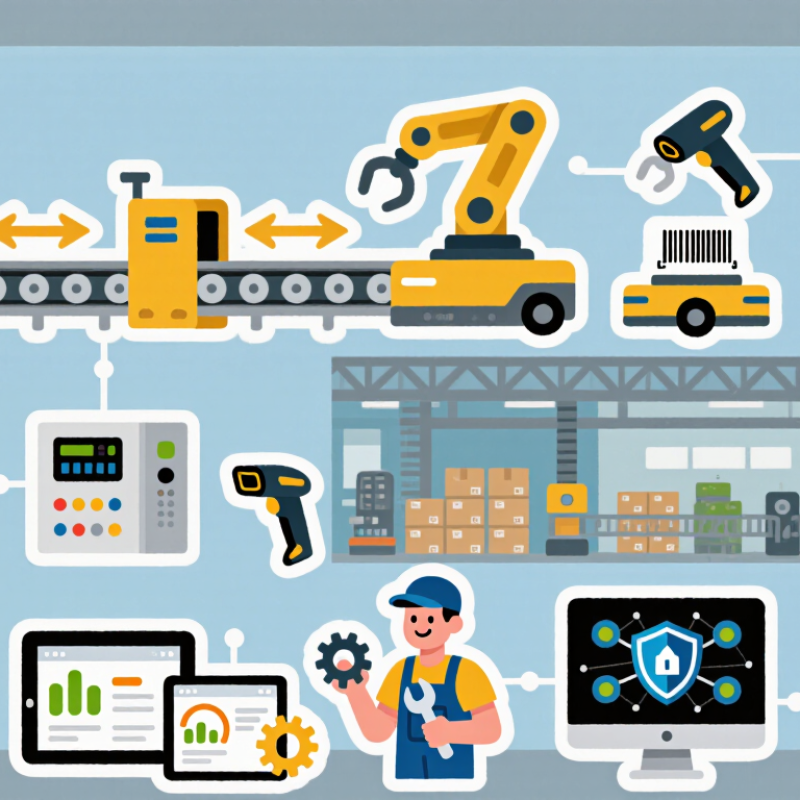
Top 10 Types of Automation Systems for Global Buyers
Define the Ten Automation Types by Industry, Control Layer, and Buyer Need
Global buyers should classify automation by use, control layer, and operational risk. In discrete manufacturing, PLC-based cell automation coordinates sensors, actuators, and machine cycles. Motion and robotic systems serve high-speed assembly, packaging, and material handling. Machine-vision automation checks labels, dimensions, and surface defects. Process automation uses distributed control for fluids, heat, pressure, and continuous production.
Batch automation manages recipes, mixing stages, and traceability in food, chemical, and pharmaceutical operations. SCADA systems supervise water, energy, and utility networks across distant sites. Building automation controls ventilation, lighting, access, and energy consumption. Warehouse automation connects conveyors, storage equipment, scanners, and inventory software. Safety instrumented systems protect people and equipment during hazardous process conditions. Edge and cloud-connected automation supports remote monitoring, predictive maintenance, and multi-site reporting.
A neat classification can mislead. These systems often overlap. A packaging line may combine PLC control, robotics, vision, safety functions, and cloud reporting. I have seen projects fail because buyers selected hardware before defining response time, production volume, and service skills. Control-layer clarity matters: field devices collect signals, controllers execute logic, supervisory platforms display performance, and enterprise systems guide decisions. The best choice depends on downtime cost, expansion plans, cybersecurity controls, and local technical support.
Tips: Request a practical factory trial. Check cycle time, alarm handling, spare-part access, and operator training. Ask for test records, maintenance intervals, and clear responsibility during commissioning. Do not assume a sophisticated system is automatically suitable. Simpler control can be more reliable, although this judgment deserves careful review.
Global automation discussions often begin with a striking figure: 4.28 million industrial robots operating worldwide. This figure, reported by an international robotics federation, shows market scale, not automatic suitability. Robots handle repeated welding, painting, palletizing, and assembly tasks with consistent speed. They need guarded space, accurate programming, and planned maintenance.
Cobots work beside trained operators and usually support lighter assembly, inspection, or packaging tasks. Their advantages include flexible deployment and simpler changeovers. Payload matters. A cobot may not match a conventional robot during fast, heavy production. PLCs provide the control logic behind sensors, motors, conveyors, and safety circuits. They coordinate the factory’s timing, often in milliseconds. CNC systems control cutting tools with tight dimensional accuracy, making them valuable for metal, plastic, and composite parts.
Buyers should compare cycle time, payload, reach, tolerance, floor space, energy use, and operator training. A low purchase price can hide integration costs. Vision systems, grippers, fixtures, software, and safety validation may cost more than expected. Integration is harder. On one production line, a PLC upgrade may deliver more value than a new robot. On another, a CNC machine may remove a bottleneck immediately. The 4.28 million installed robots offer useful industry evidence, but they cannot replace a site survey, process trial, or careful risk assessment. Even experienced teams sometimes overestimate automation returns during the first year. That mistake deserves review before expanding the system.
A practical comparison of major industrial and operational automation systems by primary function, typical applications, deployment profile, and buyer considerations.
| Rank | Automation System | System Category | Primary Function | Typical Applications | Typical Operating Scale | Key Advantages | Main Limitations | Integration and Skills | Best Fit for Global Buyers |
|---|---|---|---|---|---|---|---|---|---|
| 1 | Industrial Robot Cells | Robotic automation | Automate repetitive handling, assembly, welding, painting, palletizing, and material-transfer tasks. | Automotive production, metal fabrication, packaging, electronics assembly, warehouse palletizing, and machine tending. | Usually 4–6 axes; payload and reach vary widely by application, from compact handling to heavy industrial operations. | High repeatability, long operating life, consistent cycle performance, and suitability for hazardous or physically demanding work. | Requires safety guarding or validated protective measures; changeovers and programming may require specialist support. | Medium to high integration effort involving mechanical design, safety engineering, end-of-arm tooling, controls, and programming. | Best for high-volume, repeatable production with stable product geometry and clear cycle-time targets. |
| 2 | Collaborative Robot Systems | Human-robot collaboration | Perform selected tasks alongside workers using force, speed, separation, and other safety functions. | Light assembly, screwdriving, inspection, packaging, kitting, laboratory handling, and machine tending. | Commonly used for light- to medium-duty tasks where human access and frequent product changeovers are important. | Compact footprint, comparatively accessible programming, flexible redeployment, and reduced need for full physical guarding in suitable applications. | Speed and payload can be lower than conventional industrial robots; every application still requires a documented risk assessment. | Medium integration effort; worker training, risk assessment, tooling, and task-specific validation remain essential. | Best for small and medium-sized manufacturers, mixed-model production, and processes requiring close human interaction. |
| 3 | Autonomous Mobile Robots (AMRs) | Intralogistics | Transport materials or goods through facilities using onboard navigation and dynamic route planning. | Line-side delivery, warehouse replenishment, picking support, hospital logistics, and work-in-process movement. | Navigation is generally software-defined; payload, travel speed, battery capacity, and fleet size depend on the vehicle configuration. | Flexible routes, limited fixed infrastructure, scalable fleet deployment, and improved visibility of internal material flows. | Performance can be affected by traffic, floor conditions, connectivity, battery charging, and changing facility layouts. | Medium integration effort involving mapping, fleet software, warehouse or manufacturing-system interfaces, and traffic management. | Best for facilities with variable routes, frequent layout changes, and a need to reduce manual transport. |
| 4 | Automated Guided Vehicle Systems (AGVs) | Fixed-route logistics | Move materials along predefined routes using guidance infrastructure or mapped paths. | Raw-material delivery, pallet movement, warehouse transfers, and repetitive factory transportation loops. | Designed for predictable routes and repeatable loads; fleet capacity is normally planned around defined traffic patterns. | Reliable repeatability, structured traffic control, and suitability for stable, high-frequency transport routes. | Less flexible than AMRs when routes, workstations, or facility traffic patterns change significantly. | Medium to high integration effort involving route planning, charging, safety zones, facility changes, and production-system interfaces. | Best for large facilities with stable layouts, repeatable transport missions, and clearly defined material flows. |
| 5 | PLC-Based Control Systems | Machine control | Execute deterministic logic for sensors, actuators, motors, valves, conveyors, and complete automated machines. | Packaging lines, assembly equipment, conveyors, water treatment, material handling, and discrete manufacturing cells. | Controls range from small machine-level systems to distributed line architectures with multiple controllers and remote I/O. | Fast scan cycles, high reliability, modular expansion, strong diagnostics, and suitability for continuous industrial operation. | Programming and troubleshooting require controls expertise; complex motion, data, and cybersecurity requirements may increase scope. | Medium integration effort involving electrical design, ladder or structured programming, networking, HMI configuration, and commissioning. | Best as the core control layer for discrete machines and production lines requiring deterministic operation. |
| 6 | CNC Machine Systems | Computerized machining | Control cutting, drilling, turning, milling, grinding, and other precision machining operations. | Metalworking, aerospace components, medical parts, tooling, automotive components, and precision job shops. | Uses multi-axis coordinated motion; 3-axis, 4-axis, and 5-axis configurations are common for different part geometries. | High dimensional accuracy, repeatable tool paths, digital program storage, and efficient production of complex geometries. | Requires suitable tooling, fixturing, cutting parameters, material knowledge, and regular maintenance of machine accuracy. | Medium integration effort involving CAD/CAM workflows, post-processing, workholding, tooling, inspection, and operator training. | Best for precision parts, repeat production, complex geometries, and applications where dimensional consistency is critical. |
| 7 | Machine Vision Systems | Inspection and sensing | Capture and analyze images to identify defects, verify assembly, measure features, read codes, or guide motion. | Quality inspection, label verification, optical character recognition, presence checks, sorting, and robot guidance. | Performance depends on camera resolution, lighting, lens selection, image-processing method, and product presentation. | Non-contact inspection, rapid data capture, traceable results, and consistent evaluation of visual characteristics. | Lighting, reflections, part variation, contamination, and poorly defined acceptance criteria can reduce reliability. | Medium integration effort involving optics, lighting, image processing, data interfaces, and production validation. | Best for repeatable visual characteristics that can be clearly defined and measured automatically. |
| 8 | SCADA and HMI Systems | Supervision and visualization | Monitor equipment, display process status, record alarms and trends, and provide operator control interfaces. | Utilities, process plants, production lines, energy systems, water treatment, and geographically distributed assets. | Can supervise a single line or aggregate data from multiple sites, controllers, sensors, and industrial networks. | Improves operational visibility, alarm management, historical reporting, troubleshooting, and centralized supervision. | Does not replace field-level control; poor alarm design, weak network architecture, or inadequate cybersecurity can create risks. | Medium to high integration effort involving data tags, network architecture, historian configuration, user roles, and cybersecurity controls. | Best for operations that need centralized monitoring, historical data, alarms, and multi-level process visibility. |
| 9 | Distributed Control Systems (DCS) | Continuous-process control | Coordinate large-scale continuous or batch processes with distributed controllers, control loops, and operator stations. | Chemicals, refining, power generation, pharmaceuticals, food processing, and other process industries. | Designed for many interconnected control loops, process variables, remote I/O points, and high-availability operating environments. | Strong process-control functionality, centralized engineering, redundancy options, alarm handling, and lifecycle management. | Higher initial engineering complexity and lifecycle cost than small machine-control systems; migration planning can be demanding. | High integration effort involving process engineering, instrumentation, control-loop tuning, cybersecurity, commissioning, and operator training. | Best for large continuous or batch processes where stable control, availability, and coordinated plant operation are priorities. |
| 10 | Robotic Process Automation (RPA) | Software automation | Execute rule-based, repetitive digital tasks across applications, documents, databases, and web interfaces. | Order processing, invoice handling, data entry, reporting, customer-service administration, and compliance workflows. | Scales through software agents and workflow orchestration rather than physical payload, reach, or machine cycle time. | Rapid deployment for structured tasks, reduced manual keystrokes, improved transaction consistency, and digital audit trails. | Fragile when interfaces or business rules change; poorly structured data and exceptions require human oversight or redesign. | Low to medium integration effort for simple workflows; higher effort for governance, identity management, testing, and enterprise integration. | Best for repetitive, rules-based office and back-office processes with stable digital inputs and measurable transaction volumes. |
Reference point: The International Federation of Robotics reported approximately 4.28 million operational industrial robots worldwide at the end of 2023. The figure refers to installed industrial robots and should not be interpreted as the total installed base of all automation system types listed above. Capability, cost, safety requirements, and integration effort vary by application and local regulations.
SCADA, MES, IIoT, and digital twins perform different jobs within ISA-95 integration layers. SCADA watches equipment and displays alarms near real time. MES manages production orders, quality records, labor, and traceability. IIoT connects sensors across machines and sites. Digital twins simulate assets, processes, or entire production lines. Their value depends on clean interfaces, not fashionable terminology.
The International Society of Automation places these functions across control, operations, and enterprise levels. That structure helps buyers avoid forcing one system to solve every problem. The 2024 World Robotics report recorded 541,302 industrial robot installations worldwide in 2023.
More connected machines create richer data, but also expose weak governance. A digital twin built on incomplete sensor data may look impressive and still mislead maintenance teams. I have seen dashboards multiply while decisions remain slow. That gap deserves scrutiny.
Tips: Map each requirement to an ISA-95 layer before comparing suppliers. Confirm tag naming, timestamps, cybersecurity controls, and offline behavior. Ask whether MES can exchange production data with enterprise planning systems. Test one production cell first. Then measure downtime, changeover time, and record accuracy. A 2024 smart-manufacturing survey found that 86% of manufacturers expect smart operations to become important for competitiveness within five years. The number is persuasive, but readiness varies sharply by plant. Use the percentage as context, not proof.
Global buyers should compare automation systems through measurable throughput and safety data. A fast machine is not always the best fit. Start with peak units per hour, average cycle time, queue length, and equipment availability. Measure performance during shift changes and product variation, not only in controlled tests.
AGVs suit stable routes and predictable pallet movement. Their throughput depends on traffic rules, charging time, and loading accuracy. AMRs adapt better to changing layouts, but route decisions can increase travel time. Track missions per hour, near-miss events, stopping distance, and pedestrian interactions. Shorter routes help. Poor floor markings still create risk.
AS/RS systems deliver high storage density and repeatable retrieval times. Buyers should examine crane speed, bin access, recovery procedures, and system uptime. Conveyors can provide steady flow, especially between fixed workstations. Yet a single blockage may stop an entire line. That weakness deserves attention. Our early throughput estimate ignored manual replenishment, and the result was too optimistic. Use observed data from similar loads, then test emergency stops, safe separation distances, restricted zones, and restart procedures with trained operators. Safety performance needs documented inspections, sensor checks, and clear accountability. Metrics should be reviewed after installation, because real facilities rarely behave exactly like simulation models.
Assess AGVs, AMRs, AS/RS, and Conveyors by Throughput and Safety Metrics
Throughput values show representative planning benchmarks in handled units per hour. Because unit types differ across systems, pallet, tote, carton, parcel, and order-line applications should be compared within the same operating context. The safety-readiness index is a normalized 1–5 planning indicator based on commonly applied safeguards such as guarding, emergency stops, safety scanners, monitored speed, and protective separation; it is not a legal certification or a substitute for a site-specific risk assessment.
Global buyers often evaluate ten automation categories: RPA, building automation, process control, SCADA, PLC systems, DCS, MES, IIoT, warehouse automation, and energy management. Each category creates different cyber risks. IEC 62443 offers a practical screening method, not a simple compliance sticker.
For RPA, buyers should inspect identity controls, privileged access, bot credentials, and audit trails. Building automation needs secure gateways, segmented networks, and protected controllers. Process control demands stronger separation between safety, control, and business networks. IEC 62443-3-3 defines requirements for zones, conduits, authentication, system integrity, and data confidentiality. IEC 62443-4-1 also examines secure product development processes.
Small gaps matter.
The 2024 Data Breach Investigations Report found that human involvement appeared in 68% of breaches. That figure makes unattended bots, shared engineering accounts, and weak remote access especially concerning. Buyers should request asset inventories, patch evidence, vulnerability handling procedures, and recovery exercises. Supplier security declarations help, but they are not enough. In real facilities, outdated controllers may remain active for years. Procurement teams should test whether security controls work during production pressure, not only during a formal audit. A 2024 global industrial cybersecurity survey also reported continuing concern about ransomware, remote connectivity, and limited security staffing. IEC 62443 alignment should therefore be scored across architecture, operations, maintenance, and incident response. The uncomfortable question is simple: can the site isolate one compromised device without stopping everything?
© 1999-2025 The Lincoln Electric Company