Choosing the best robotics course in 2026 depends less on a flashy title and more on what you want to build. A beginner may need clear lessons in sensors, motors, and basic programming. An experienced learner may want control theory, computer vision, or autonomous systems. The right fit is personal.
Robotics researcher Rodney Brooks once wrote, “The world is not a desktop.” That observation matters when comparing courses. Robots must respond to real surroundings, not just tidy simulations. Look for practical work with physical components, or realistic projects that explain what changes when code meets hardware. A course should also teach debugging, safety, and how to test results—not only how to make a robot move.
Small details count. Can you inspect the syllabus before enrolling? Does the instructor explain prerequisites? Are projects supported by feedback, and can learners access the required tools? These questions help separate useful training from polished marketing. No single robotics course suits everyone. Course descriptions can also make hands-on learning sound easier than it is. That deserves a little skepticism.
This guide compares options by teaching quality, practical depth, flexibility, and value. It considers both newcomers and learners seeking more advanced skills. The goal is not to crown a universal winner, but to help you choose a course that matches your experience, budget, and next project. Expect trade-offs. A course with excellent theory may offer limited hardware practice, while a project-rich program may move quickly through fundamentals. The best choice is the one whose limits you understand and whose work you can actually complete.
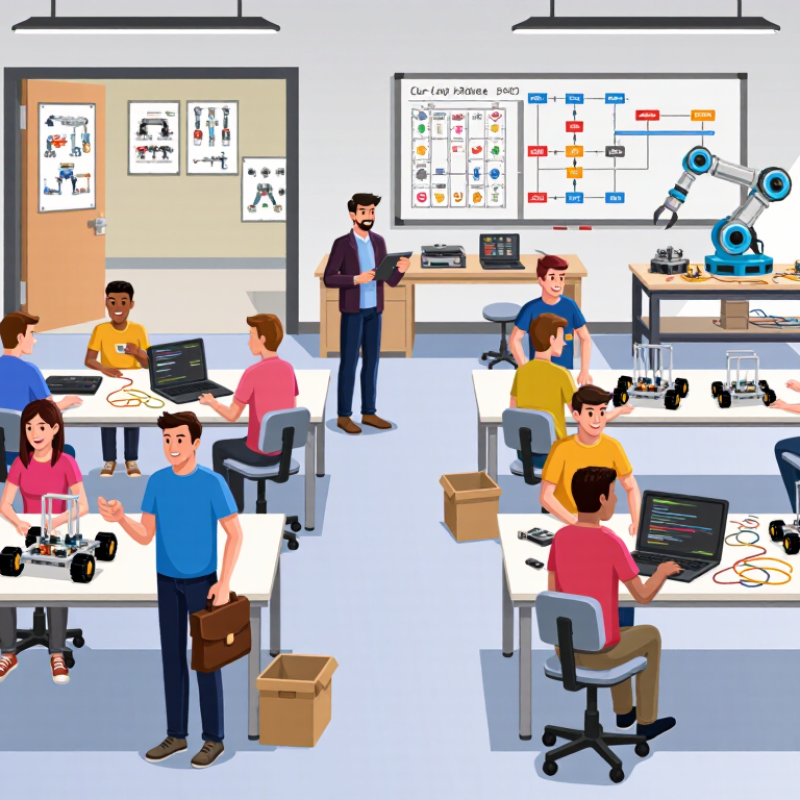
A robotics course in 2026 should teach students to make machines sense, decide, and move—not merely assemble a kit. Core lessons should connect mechanics, electronics, programming, control systems, and perception. Students should test their work in simulation, then on physical hardware: a wheeled robot drifting across a marked floor reveals calibration errors that a clean screen may conceal. The International Federation of Robotics reported 4.28 million industrial robots operating worldwide in 2023, with 541,302 new installations that year. That scale makes practical integration skills essential, not decorative.
Look for courses that require a complete project, from sensor readings to reliable movement, and teach students to document failures as carefully as successful runs. Safety, troubleshooting, and clear technical communication belong in the curriculum too. The World Economic Forum’s Future of Jobs Report 2025 estimates that 39% of workers’ core skills will change by 2030, reinforcing the value of adaptable learning. Real friction. A course can still fall short if it relies too heavily on simulation or gives little time with hardware. Ask how often learners test physical systems, interpret noisy sensor data, and revise designs after a failed run. A neat demo is useful; repeatable results matter more.
A strong robotics course should teach students to connect code with physical behavior. They should program motion, read sensors, tune control loops, and diagnose failures at the workbench. The International Federation of Robotics reported 541,302 industrial robot installations worldwide in 2023. That scale makes practical integration skills essential, not optional. Students should also learn mechanical design, basic electronics, safety procedures, and clear documentation. A robot that moves is not necessarily a reliable robot.
The World Economic Forum’s Future of Jobs Report 2025 says 39% of workers’ core skills are expected to change by 2030. Its findings strengthen the case for teaching adaptable problem-solving alongside technical skills. Learners should test assumptions, interpret data, and explain why a system behaves differently on carpet than on a smooth lab floor. A course can still overvalue polished demonstrations. One successful run does not prove mastery; repeated testing matters.
Tips: Seek courses with hands-on projects, sensor calibration, and structured troubleshooting. Ask whether students must explain failures, not just present working prototypes. Keep a simple lab notebook: record the change, the result, and what remains uncertain.
A strong robotics course connects software, electronics, mechanics, and system-level testing. Use this checklist to assess whether a course includes the core skills and practical evidence needed to build and evaluate working robots.
| Core skill | What the course should teach | Suitable hands-on activity | Evidence of learning | Why it matters |
|---|---|---|---|---|
| Programming | Variables, functions, data structures, debugging, and writing modular code for robot behavior. | Write a program that reads sensor input and controls a robot’s movement. | Working code with clear logic, useful error handling, and repeatable behavior. | Robots rely on software to interpret inputs, make decisions, and control actuators. |
| Mathematics and coordinate frames | Vectors, angles, trigonometry, coordinate transformations, and basic probability. | Calculate a robot’s position or convert a target location between coordinate frames. | Correct calculations that can be checked against known positions or measurements. | Robots need spatial representations to move, locate objects, and combine sensor data. |
| Mechanics and design | Degrees of freedom, linkages, gears, torque, stability, and basic computer-aided design. | Design or assemble a mechanism that can move an object within specified limits. | A mechanism that moves reliably, with design choices linked to its intended task. | Mechanical choices affect a robot’s reach, payload, stability, and energy use. |
| Electronics and actuation | Voltage, current, circuits, motor drivers, power supplies, and safe wiring practices. | Connect a motor and driver, then control speed or direction with a microcontroller. | A correctly wired circuit and controlled actuator operation without exceeding component limits. | Robots need dependable power and electrical interfaces to operate motors and sensors. |
| Sensors and measurement | How encoders, inertial sensors, distance sensors, and cameras produce measurements, including their limitations. | Collect sensor readings and use them to trigger a simple robot response. | Recorded readings, basic calibration, and an explanation of noise or measurement error. | Sensor data helps a robot estimate its state and respond to its surroundings. |
| Control systems | Feedback, open- and closed-loop control, setpoints, error, and introductory PID control. | Control a motor or mobile robot to reach and maintain a target speed or position. | Measured response showing how the system behaves when the target or conditions change. | Feedback helps robots correct deviations and achieve more consistent movement. |
| Robot software architecture | Separating software into components, exchanging messages, handling timing, and using simulation where appropriate. | Build a small system in which separate components exchange sensor and command data. | A working integrated program with documented interfaces and reproducible setup steps. | Robotics projects combine multiple functions that must communicate reliably. |
| Perception and computer vision | Image representation, camera basics, feature or object detection, and the limits of visual data. | Detect a colored object or a simple visual feature and use the result in a task. | Test results across different lighting or viewing conditions, with known limitations recorded. | Perception enables robots to interpret visual information from their environment. |
| Localization and navigation | Odometry, map representations, path planning, obstacle avoidance, and sources of position error. | Make a mobile robot follow a route while responding to an obstacle. | A route test with recorded position or movement data and an explanation of errors. | Mobile robots need to estimate where they are and choose safe routes to destinations. |
| Integration, testing, and safety | System testing, troubleshooting, risk assessment, emergency stops, and responsible use of robots. | Complete a project that combines sensing, decision-making, and actuation, then test it against defined conditions. | A documented test plan, observed results, identified failure cases, and appropriate safety measures. | Real systems must work as a whole and be evaluated for safe, predictable operation. |
Course-selection tip: Prefer courses that provide practical work across several of these areas, require students to test integrated systems, and explain how performance and safety are evaluated.
Robotics courses differ less by their labels than by what students actually build. A self-paced course may teach basic coding, sensors, and coordinate frames through simulations. It is flexible, but virtual wheels never snag on a cable. In-person classes add motors, wiring, and the small frustration of a loose connector. That detail matters. Learners who need quick feedback may benefit from an instructor watching them debug.
Difficulty depends on the starting point and the project. Beginner courses often use block-based coding, simple circuits, and guided tasks, such as making a small rover follow a line. Intermediate study may introduce algebra, vectors, and feedback control. Advanced work can involve robot-arm kinematics, computer vision, or planning routes around obstacles. The jump is real. Still, course labels are imperfect: one “beginner” class may assume prior coding, while another teaches it from scratch.
Compare the weekly workload, required tools, and amount of hands-on practice before enrolling. A simulation-heavy course suits learners without equipment or workshop space. A physical kit offers tactile problem-solving, though setup can consume time that tutorials rarely mention. Check how assignments are assessed, too: a working robot is useful evidence, but clear explanations of failed tests reveal understanding. I would not treat polished course descriptions as proof of difficulty; inspect a sample lesson or project brief when possible.
A strong robotics course is not automatically the best fit for every learner. Start by naming your goal: building a small mobile robot, preparing for technical work, or exploring research. Then compare each course’s projects with that goal. A syllabus mentioning sensors is less useful if you never get to connect one, read its output, and troubleshoot it. Look for hands-on practice with components such as motors, distance sensors, and microcontrollers. Check the expected math, coding level, weekly workload, and access to equipment. Small details count.
Tips: Read a sample lesson and inspect a project rubric. Ask how often learners receive feedback, and whether materials are available for practice outside class. Compare the full time commitment, not just the advertised course length.
Evidence matters more than ambitious promises. Look for clear project examples, specific learning outcomes, and transparent prerequisites. If possible, ask a recent learner what they actually built and where they struggled. Course descriptions can sound polished; they may not show how much guidance beginners receive. I would also leave room for personal preference: a course with more theory may suit one learner, while another needs frequent experiments. No comparison is perfect, but matching the teaching style and project work to your next step makes the choice more grounded.
Compare course pathways by how well their typical focus aligns with different learning goals.
How to read this chart: Ratings are indicative curriculum-fit scores from 1 (limited focus) to 5 (strong focus), not measured outcomes or ratings of specific courses. Check each syllabus, project work, and prerequisites against your own goals before choosing.
The best robotics course in 2026 depends on what a learner wants to build, not on flashy promises. The International Federation of Robotics reported 541,302 industrial robots installed worldwide in 2023, in World Robotics 2024. That figure signals a complex field, not a guaranteed job outcome. Choose a course with clear learning steps.
Newcomers benefit from visual coding, safe simulations, and guided work with motors, sensors, and simple robotic arms. Look for lessons that explain why a sensor misses a dark object, not just how to copy code. Career changers may need refreshers in algebra, electronics, and Python, followed by a small portfolio project. Real hardware matters. Remote learners should check whether kits are included, loaned, or replaced by realistic simulation.
Experienced technicians may value debugging logs, motion planning, and system integration more than introductory coding. The World Economic Forum’s Future of Jobs Report 2025 estimates that 39% of workers’ existing skills may be transformed or outdated by 2030. Courses should teach principles that transfer across tools. Still, course completion is not competence. I would not treat a polished simulator as proof of readiness. A useful assessment asks learners to calibrate a sensor, explain a failure, and revise their approach. That part gets missed.
© 1999-2025 The Lincoln Electric Company